Monday, January 19, 2015

Omission of Selma's Lead Actor and Director Means More

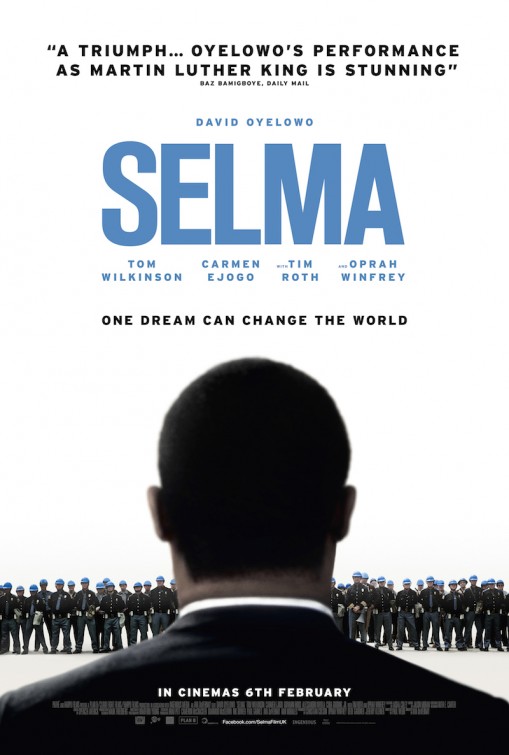
A plethora of articles have been released saying that the recent film Selma was “snubbed” out of Oscar nominations for a number of reasons. Some suggest theories such as racial conspiracies, or the fact that the Academy voters are Oscar voters are nearly 94% Caucasian and 77% male reported by the L.A Times. I think that the cause is similar to a concept often seen on T.V.
Though it was nominated for Best Picture this year for the Oscars, Selma needed to be at the forefront of Oscar’s publicity. Some of the final polarizing events of 2014 included the police incidents in Ferguson, Missouri and Staten Island, New York. This year especially we need to show that the culture about race is changing in America. However this necessity of change was not displayed as well as many wished once the final nominations were released.
This is because the “token” black award had already filled last year. In 2013, 12 Years A Slave, highlighting a story about a captured slave,  received numerous awards. Some believe that according to the Academy, that category has been checked off at least for the time being. The Oscars organization has promised diversity improvement in the past and it is slowly changing, but I emphasize slowly. At least Selma was nominated for best picture with a young, woman of color directing the movie. That is definitely progress, but the pace of change just needs to be quickened.
I hope the amount of public outcry towards this decision has the ability to be a catalyst in the changing of how the voting is conducted. 


Wednesday, January 14, 2015

Detroit Saves It's Art Museum


A bright light shone briefly on the City of Detroit as it approved its bankruptcy plan. It was able to refrain from selling $600 million dollars worth of artwork from the Detroit Institute of Arts in a miraculous philanthropic effort from foundations across the country. As a public holding of the City of Detroit, the museum was designated to raise $600 million through the sale of pieces from its collection. However, through extensive fundraising, the Detroit Institute of Arts was able to raise the funds from multiple foundations. In addition to the required funds, the State of Michigan even contributed a large portion. 

While art enthusiasts and museum-goers are celebrating their victory, it could be short lived. The struggling city has devised its bankruptcy plan to start the journey back to normalcy, but a bad turn could once again put the spotlight on the Detroit collection, valued at approximately $8.1 billion dollars. The museum’s collection is seen as an easily dispensable source of major income for the city in this time of crisis, but it is not something that can be rebuilt after the city recovers. Auto industry families donated most of the museum’s most influential pieces in the early 20th century and the valuation of such work has increased dramatically. It is amazing that these private foundations have to intervene in order to protect this culture owned by the state. Unlike many other museums, the Detroit Institute of Arts is owned by the city and many saw it as a way to speed up the recovery process through a quick sale. This would help people be able to receive benefits from the city, but the art that would have been sold could not be replaced or a similar collection be assembled.


In an attempt to persuade the museum not to sell, the major museums across the country such as the Modern Museum of Art, The Art Institute of Chicago and many others vowed not to purchase any art if it were to go up for sale. While this combination of efforts was succesfull recently, would this collection be up for debate if Detroit returned to economic turmoil in the future? I hope that the city does not have to resort to this quick-sell opportunity and can maintain this cultural icon as long as possible. Do you think the current situation will last?


Hospital Disregards Patient Privacy for TV Show

Anita Chanko’s 83-year-old husband, Mark, was struck by a sanitation truck over a year ago, and she was not permitted to ride in the ambulance with him when he was rushed to the emergency room, where he died shortly after arrival. Over a year later while watching an episode of NY Med, a reality show filmed at New York-Presbyterian Hospital, she saw her husband’s doctor say a man came in who had been hit by a truck and knew it was not a coincidence. She saw a blurred image of her husband on the screen, recognizing his voice as she heard him ask, “Does my wife know I’m here?” Nobody from the hospital had told her that her husband had been filmed; nobody had told her what her husband had said; nobody asked her if NY Med could air his last moments on national television.
                                                          
When a family member is hospitalized, we operate under the assumption that the hospital will provide the privacy and discretion we assume. Upon entrance, extensive Health Insurance Portability and Accountability Act (HIPAA) forms are signed by both doctors and patients as a confidentiality agreement. Congress implemented this law in 1996, and these forms basically serve as a privacy guarantee for a patient’s medical information. More than 1.26 billion forms are signed each year for doctors’ visits alone.
                                                                      
However, fictional hospital dramas such as House and Grey’s Anatomy have captured a public interest in televises trauma/ER situations. In order to meet that need, real hospitals have been allowing network film crews to show patients’ experiences in a reality-show format. The issue with this is that they have not been asking for consent from patients or their families.

Hospitals seem to be hiding behind the mounds of paperwork in the HIPAA forms and the law that supposedly protects our privacy. The truth is that all that paperwork may not really mean what most Americans think it means. So much paperwork gives the illusion that the law is inviolable. The fine for simple violation, however, is only $100, and according to the Washington Post, the Justice Department has only prosecuted two criminal cases involving abuse of medical privacy. One was for stolen credit card information, and the other was for releasing an FBI agent’s files. Only two cases ever out of more than one billion forms a year. How can there be such a gulf between what a law is supposed to do and what it actually is enforcing? Why isn't the document doctors are told so much about not being considered in this case?
Anita lost her initial suit and is appealing in a civil court later this year.


Can the Apple Watch Start a Trend?

While visiting with my cousins over winter break we talked briefly about Apple's new smart watch product. I was wondering whether they thought it would sell well. After a quick consensus, we found that none of us wear watches to school on a regular basis and that we were unsure of how useful this new device will be to younger generations. According to its presentation, Apple says one can check the time, read email, use apps on your phone along with fitness tracking capabilities, and a strange heartbeat-messaging feature. After reading, none of these new features really sounded appealing to me. With the exception of being able to check the time two seconds quicker it did not seem like I would ever need or want this new watch. 

Despite this, Apple's revolutionary iPhone received similar criticism before its release in 2007. Many vowed to be content with Motorola flip phones and were apprehensive about the new device. We have seen how that worked out with almost one half billion iPhones sold. Watches have been decreasing in popularity as of recent years, and especially in younger generations. With Apple's following of millennials, will it bring watches back to a norm? Apple is not the first company to roll out a new smart watch, brands like Pebble and Samsung already have their rendition on the market, but Apple is in a unique position to once again be a catalyst in technology and also in style.

Apple’s position of power gives them the ability to start a major reinvention of the watch industry. Younger generations have been purchasing watches less frequently but sales numbers have held according to BBC. They just have to have a product that people will stand behind. Do you think customer’s brand loyalty to Apple will be a deciding factor deciding whether or not to purchase the watch? The watch is projected to release this March at $349.


Thursday, December 18, 2014

The Myth of Black Friday and Holiday Deals Needs to Stop

Have you finished your holiday shopping this year? Did you take advantage of the amazing Black Friday and Cyber Monday deals we have been hearing so much about? Well, according to Wirecutter magazine, 99% of the advertised deals are not much of a deal at all. I happened to see a video of a Houston area Walmart where a brawl erupted between two customers going after a new T.V. How good was this deal they were fighting over? In an article from Forbes magazine, big name retailers like Walmart and Sears inflate regular prices of items in order to advertise larger discounts. One deal listed a Samsung 1080p T.V for a discounted $599.99 down from a regular price of $1,199.99. However, the same exact T.V was listed in their store $807.49 earlier this year.
A similar situation unfolded at Macy’s where the popular Breville toaster was listed for $280 and advertised a major discount down from $417. This same exact appliance was listed on Amazon. Priced at $250, it was not part of a sale but had been listed at that price for months. Does Macy’s think that customers just won’t compare deals? Or are they banking on the fact that their deal will be more appealing at a store which people know for appliances? The truth is they are hoping to get lucky.
Let’s say you saw saw a pair of headphones a relative wanted, and it was listed for 50% off, wouldn’t you jump at it immediately? If the price three weeks ago was $100, the retailer could list the regular price as $200. On Black Friday, you would pay the same price as before. This example may seem like an extreme, but it is not far from the truth in some cases.
Part of what makes these discounts so large is the difference from their “regular” price. I listed regular price in quotations marks because there is no definition to that term.  The Breville toaster from Macy’s never actually sold for $417 but according to Julie Strider Fukami, a spokeswoman for Macy’s, these prices can be determined from “different factors, including the cost of the item, overhead, benefits we offer… as well as our ability to offer the item at a lower price.” “Regular” price functions as whatever the retailer decides it to be.

We are stuck in a sort of tug of war between consumers being deal obsessed and retailers wanting to supply them with deals by any means possible. There needs to be more transparency from retailers on what their regular price actually is. Not a fluffed up ballpark number so customers think they have found the needle-in-the-haystack deal this year.

Sunday, December 7, 2014

The Final Spot Goes to... You Guessed it, Ohio State

Who belongs in the 4th spot of the college football playoff?

That was the question under frantic debate up until this morning when the finalists were announced on ESPN. Alabama and Oregon are in due to record and strength of schedule (if Alabama were left out it might be the cause of WWIII). The third slot went to the undefeated Florida State Seminoles. And the tie-breaker of sorts went to Ohio State, which meant TCU and Baylor were left out of the fun, and very upset about it. Why did Ohio St. deserve that spot?  A: they are a storied program; B: they have a massive nationwide following; C: they have a larger student body; and finally D: because thats who is "supposed" to get in because of tradition.

The board who made these decisions evaluated a number of factors, but let’s talk about the three teams in question. Here are the supposed reasons as to why the rankings played out like they did:

Ohio State: 1 loss to Virginia Tech 21-35

Early in their season the Buckeyes lost to Virginia Tech is a surprise upset, but everyone seems to have forgotten that. This weekend Ohio State shutout Wisconsin in a big way with a third string quarterback in the game. Bravo. But lets not forget, if Wisconsin’s Melvin Gordon is stopped (which he was), Wisconsin has no chance.That same Wisconsin team lost to Northwestern, and barely beat Minnesota earlier this year. Yes, their halfback is a Heisman candidate, but they are overrated and most people know it. Therefore the amount of credit given for this win is too much.

TCU: 1 loss to Baylor 58-61
TCU had the third seed going into this weekend and beat Iowa St 55-3 yesterday. This morning they dropped to the sixth ranking. They went from three to six and they almost won by 50 points! In response to the news TCU’s coach Gary Patterson said this today, “If we want to control our own destiny, we need to be undefeated.” I guess so because with their only loss being to their Big 12 co-champion Baylor, and with the beating they put forth this weekend, I am not sure they could have done anything more. They showed amazing growth from a 4-8 season last year.

Baylor: 1 loss to West Virginia 27-41
Baylor was ranked at 5 last week and executed a solid win this week against a ranked Kansas St. team, but it was not enough to push them over the top. One would think they would be arguably as fit as anyone to fill the fourth spot. In addition, they did beat TCU, who was one of the other contenders for the fourth spot. However, Baylor had a very weak non-conference schedule which did not help their case.

The debate between Baylor and TCU is one that shows no clear winner. But it seems logical that one of them would be filling the fourth spot. In the end the committee went with a choice that will bring more national viewers, and a bigger level of hype for a matchup with Alabama. Even though it was what we were all expecting it is still disappointing. If you were hoping this new playoff system would be more fair, then I guess it may not your year.