Friday, February 27, 2015

News Anchor Uses Opportunity to Fight Racism

Dale Hansen is a sports reporter for the Dallas/Fort Worth WFAA-TV station. Through his employment, thousands of people every week see his sports coverage and opinions, and he took the opportunity to not only provide his input on a situation, but educate on why racism is still prevalent and how we can overcome it. He took a risk that is not only extremely important, but one that should be taken more by people with the opportunity to impact so many.  

The story he covered was of an incident at Flower Mound High School. During a basketball game last week in Texas, student fans of the Flower Mound team were broadcasted holding signs that read "white power". While the students had their signs taken away, Hansen felt that it was not sufficient in teaching the students their lesson. He elaborated that it was not the students fault, but rather their parents, teachers, administrators, and coaches for influencing them. Hansen explained that racism doesn’t get developed by kids, but from their surroundings.

Bringing up a story about his childhood, Hansen explains how he was once like those kids. He speaks about how he was "raised by a man who used the n-word like it was a proper noun." In the small Iowa town in which he was raised there was one black family. His father liked that family but, felt “all the others he didn't know, they were the bad people".

He ends his segment with a powerful quote from Albert Einstein. “The world will not be destroyed by those who do evil, but by those who watch them without doing anything”. He acknowledges not everyone will change, but he thinks there is the ability to change when kids are exposed to a new environment. At the shows conclusion he says, “I’ll answer the emails tomorrow” to which his fellow anchor responds, “You’ll likely have a full inbox ”.

He knows the consequence of his actions and some of the negative response he will receive. However he still tries to make a point with a great arguement and personal anecdote. We need more opinionated news anchors using their power to change rather than just faces reading the teleprompter.


Sunday, February 22, 2015

Marshawn Lynch Just Changed Media Interaction in Sports

            Throughout this year’s season, and highlighting the lead up to the Super Bowl was the antics of Marshawn Lynch towards the general media. He made it very clear he didn’t want to answer their questions and that he “was only there so he won't get fined.” Over the course of the season he received over $100,000 in total fines and was in constant battle with the NFL on the rules mandating players to speak with reports after games. But, his efforts might just be the spark to alter rules about athlete's requirement of speaking with the press.
            Many players across professional sports resent the media. Whether they feel they are annoying, don't have much to say to them, or feel uncomfortable during interviews there is always a back and forth between the players and the press. In post-game interviews some have adopted somewhat robotic responses in order to meet the requirement. Others choose to: barely respond, make jokes or sarcastic comments, or try to make the media look stupid. Lynch’s challenge towards authority is not the first but it may prove to be the most influential.
            Coaches also wage a similar battle. Bill Belichick of the New England Patriots as well as Gregg Popovitch of the San Antonio Spurs have been pushing the line for many years. Both refuse to answer questions, and also attack reporters at times. Here a brief clip:


            The recent blowup about speaking to the media might be the catalyst for change across the 4 major professional sports. Even after this year prominent figures are challenging authority more. Kevin Durant spoke at this weekend's All-Star Game and commented on how he is not happy with the media.
"You guys really don’t know (expletive). To be honest, man, I’m only here talking to y’all because I have to," Durant said. "So I really don’t care. Y’all not my friends. You’re going to write what you want to write. You’re going to love us one day and hate us the next. That’s a part of it. So I just learn how to deal with y’all."
            Durant sheds his “nice guy” persona he maintained earlier in his career and makes clear that he is done conforming to the set standards. While many of his sponsors were not happy with his words he is tired of trying to maintain an alternate self to the media.
            I think Lynch's actions, as well as the combination of actions from other athletes will open doors for players to protest the current rules about media interaction. The landscape for sports coverage might be changing in favor of the players, but the media, as well as the leagues, will probably do all they can to stop it.

Monday, January 19, 2015

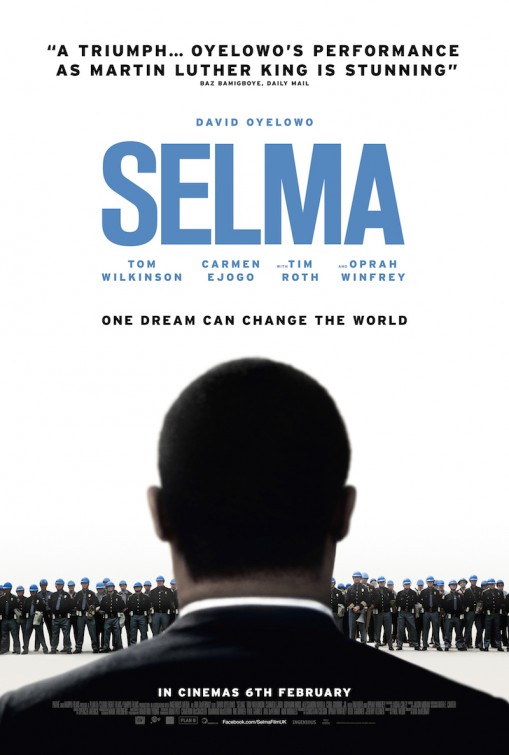
Omission of Selma's Lead Actor and Director Means More

A plethora of articles have been released saying that the recent film Selma was “snubbed” out of Oscar nominations for a number of reasons. Some suggest theories such as racial conspiracies, or the fact that the Academy voters are Oscar voters are nearly 94% Caucasian and 77% male reported by the L.A Times. I think that the cause is similar to a concept often seen on T.V.
Though it was nominated for Best Picture this year for the Oscars, Selma needed to be at the forefront of Oscar’s publicity. Some of the final polarizing events of 2014 included the police incidents in Ferguson, Missouri and Staten Island, New York. This year especially we need to show that the culture about race is changing in America. However this necessity of change was not displayed as well as many wished once the final nominations were released.
This is because the “token” black award had already filled last year. In 2013, 12 Years A Slave, highlighting a story about a captured slave,  received numerous awards. Some believe that according to the Academy, that category has been checked off at least for the time being. The Oscars organization has promised diversity improvement in the past and it is slowly changing, but I emphasize slowly. At least Selma was nominated for best picture with a young, woman of color directing the movie. That is definitely progress, but the pace of change just needs to be quickened.
I hope the amount of public outcry towards this decision has the ability to be a catalyst in the changing of how the voting is conducted. 


Wednesday, January 14, 2015

Detroit Saves It's Art Museum


A bright light shone briefly on the City of Detroit as it approved its bankruptcy plan. It was able to refrain from selling $600 million dollars worth of artwork from the Detroit Institute of Arts in a miraculous philanthropic effort from foundations across the country. As a public holding of the City of Detroit, the museum was designated to raise $600 million through the sale of pieces from its collection. However, through extensive fundraising, the Detroit Institute of Arts was able to raise the funds from multiple foundations. In addition to the required funds, the State of Michigan even contributed a large portion. 

While art enthusiasts and museum-goers are celebrating their victory, it could be short lived. The struggling city has devised its bankruptcy plan to start the journey back to normalcy, but a bad turn could once again put the spotlight on the Detroit collection, valued at approximately $8.1 billion dollars. The museum’s collection is seen as an easily dispensable source of major income for the city in this time of crisis, but it is not something that can be rebuilt after the city recovers. Auto industry families donated most of the museum’s most influential pieces in the early 20th century and the valuation of such work has increased dramatically. It is amazing that these private foundations have to intervene in order to protect this culture owned by the state. Unlike many other museums, the Detroit Institute of Arts is owned by the city and many saw it as a way to speed up the recovery process through a quick sale. This would help people be able to receive benefits from the city, but the art that would have been sold could not be replaced or a similar collection be assembled.


In an attempt to persuade the museum not to sell, the major museums across the country such as the Modern Museum of Art, The Art Institute of Chicago and many others vowed not to purchase any art if it were to go up for sale. While this combination of efforts was succesfull recently, would this collection be up for debate if Detroit returned to economic turmoil in the future? I hope that the city does not have to resort to this quick-sell opportunity and can maintain this cultural icon as long as possible. Do you think the current situation will last?


Hospital Disregards Patient Privacy for TV Show

Anita Chanko’s 83-year-old husband, Mark, was struck by a sanitation truck over a year ago, and she was not permitted to ride in the ambulance with him when he was rushed to the emergency room, where he died shortly after arrival. Over a year later while watching an episode of NY Med, a reality show filmed at New York-Presbyterian Hospital, she saw her husband’s doctor say a man came in who had been hit by a truck and knew it was not a coincidence. She saw a blurred image of her husband on the screen, recognizing his voice as she heard him ask, “Does my wife know I’m here?” Nobody from the hospital had told her that her husband had been filmed; nobody had told her what her husband had said; nobody asked her if NY Med could air his last moments on national television.
                                                          
When a family member is hospitalized, we operate under the assumption that the hospital will provide the privacy and discretion we assume. Upon entrance, extensive Health Insurance Portability and Accountability Act (HIPAA) forms are signed by both doctors and patients as a confidentiality agreement. Congress implemented this law in 1996, and these forms basically serve as a privacy guarantee for a patient’s medical information. More than 1.26 billion forms are signed each year for doctors’ visits alone.
                                                                      
However, fictional hospital dramas such as House and Grey’s Anatomy have captured a public interest in televises trauma/ER situations. In order to meet that need, real hospitals have been allowing network film crews to show patients’ experiences in a reality-show format. The issue with this is that they have not been asking for consent from patients or their families.

Hospitals seem to be hiding behind the mounds of paperwork in the HIPAA forms and the law that supposedly protects our privacy. The truth is that all that paperwork may not really mean what most Americans think it means. So much paperwork gives the illusion that the law is inviolable. The fine for simple violation, however, is only $100, and according to the Washington Post, the Justice Department has only prosecuted two criminal cases involving abuse of medical privacy. One was for stolen credit card information, and the other was for releasing an FBI agent’s files. Only two cases ever out of more than one billion forms a year. How can there be such a gulf between what a law is supposed to do and what it actually is enforcing? Why isn't the document doctors are told so much about not being considered in this case?
Anita lost her initial suit and is appealing in a civil court later this year.